Download expert-built N8N workflows and scale your business effortlessly.




Is n8n Dead?What Every Business Owner Needs to Know Before Choosing an Automation Tool in 2026
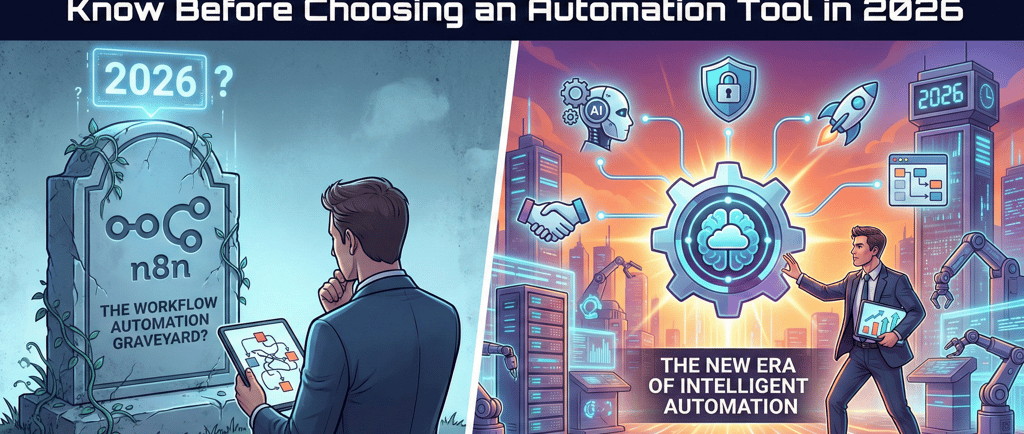
As someone who builds automations for businesses daily at BizNova, I get asked this question at least once a week: "Is n8n still worth it, or should we move to something else?" After watching Nate Herk's in-depth breakdown – one of the sharpest voices in AI automation today – the answer is clear. n8n is not dead. Not even close. Here's the full picture.
2/23/20264 min read
The Short Answer: n8n Is Not Dead
Yes, YouTube views dipped. Yes, newer tools are getting more hype. But hype and utility are two completely different things.
n8n remains the #1 visual workflow automation tool with one of the strongest developer and business communities in the space. The dip in search interest isn't a sign of death – it's a sign of maturity. The tool moved past the "shiny new toy" phase and into serious, production-grade usage.
Think of it like this: nobody makes viral YouTube videos about Microsoft Excel anymore. But every business on the planet still uses it.
Why Did People Start Asking "Is n8n Dead?"
Three things happened at the same time:
New AI tools exploded – Claude, GPT-4o, Cursor, and cloud-based code agents grabbed all the attention
"Vibe coding" became trendy – suddenly, writing Python with AI assistance felt accessible to non-developers
YouTube metrics dipped – fewer beginners were searching "n8n tutorial" because the beginner wave had already passed
But here's what the data actually shows:
Metric Reality: GitHub stars still growing month over month Community size One of the largest in workflow automation Enterprise adoption Accelerating, not declining New integrations Released weekly
Conclusion: n8n didn't die. The hype cycle moved on – and that's actually good for serious users.
n8n vs. Cloud Code: Which Should YOU Use?
This is the real question behind "is n8n dead?" – people aren't asking if it's gone, they're asking if they should switch to code-based solutions.
Here's the honest breakdown:
When n8n Wins
You need something built and deployed fast
Your team has no heavy coding background
You want visual, easy-to-maintain workflows
You need built-in error handling without writing it yourself
The workflow is straightforward (lead capture, CRM sync, notifications, follow-ups)
When Cloud Code (Python) Wins
You need complex logic that goes beyond drag-and-drop
You have a developer on staff who can maintain it
You're building something that needs deep customization
You need performance at scale (millions of operations)
The key insight from Nate Herk: it's not either/or. The smartest approach is using both – n8n for reliable visual automations, and code for the edge cases that need it.
The "10-Minute Rule" That Changes How You Think About Automation
This is the most practical framework I've seen for deciding which tool to use:
"If I can build it in n8n in 10 minutes or less – I build it in n8n."
Why? Three reasons:
Muscle memory – you're faster in the tool you know best
Built-in error handling – n8n catches failures automatically, code doesn't
Maintenance – non-technical teammates can understand and edit a visual workflow; they can't edit a Python script
Real example for a business:
text
Scenario: New lead fills out a form on your website n8n workflow (10 minutes to build): → Catch form data → Add to CRM → Send WhatsApp message to lead → Notify sales team on Slack Same thing in Python: → Write API calls for each service → Handle authentication → Write error handling → Deploy to a server → Monitor it → Debug when it breaks = 4-6 hours minimum, ongoing maintenance required
For 90% of business automations – n8n wins every time.
Should Beginners Still Learn n8n in 2026?
Yes. Absolutely yes.
If you're a business owner, operations manager, or marketer trying to automate your workflows – jumping straight into Python or cloud code environments is the wrong move.
Here's why n8n is still the perfect starting point:
Visual interface – you see exactly what happens at each step
No deployment headaches – cloud version works out of the box
Instant feedback – test each node individually
Huge template library – start from pre-built workflows
Error messages you can actually read – not cryptic stack traces
The learning path that works:
text
Step 1: Learn n8n basics (2-4 weeks) → Build your first 5 automations → Connect your CRM, email, WhatsApp Step 2: Get comfortable with API calls in n8n (1-2 months) → Learn to use HTTP Request nodes → Work with JSON data Step 3: Add AI to your workflows (ongoing) → Connect GPT-4 / Claude to your n8n flows → Build AI-powered automations Step 4 (optional): Learn Python for edge cases → Only when n8n genuinely can't do what you need
Most businesses never need Step 4.
The Real Strategy: Expand Your Toolset, Don't Replace It
The biggest mistake people make when a new tool gets hyped is thinking they need to replace what's working.
Nate Herk's approach – and ours at BizNova – is different:
n8n handles: visual workflows, reliable automations, CRM integrations, WhatsApp flows, scheduled tasks, webhook handling
Claude/GPT handles: understanding complex logic, generating code snippets for edge cases, analyzing data, writing content inside workflows
Python handles: heavy computation, custom integrations with no n8n node, performance-critical tasks
The three work together. A mature automation setup in 2026 isn't "n8n OR code" – it's n8n as the backbone, with AI and code filling in the gaps where needed.
What This Means for Your Business Right Now
If you're a business owner evaluating automation tools, here's the practical takeaway:
Don't get distracted by the hype cycle.
Every few months, a new tool gets viral attention and suddenly everyone declares the previous tools "dead." It happened to Zapier when Make launched. It happened to Make when n8n got popular. Now it's happening to n8n as AI coding tools rise.
The businesses winning with automation aren't chasing trends. They're picking reliable tools, building solid workflows, and compounding the time savings month after month.
Our recommendation at BizNova:
Business TypeStart WithFirst automation evern8n Cloud (free tier)5-50 employees, no developern8n + BizNova implementationHas a developer on staffn8n + custom Python for edge casesEnterprise with complex needsn8n Enterprise + cloud infrastructure
FAQ: n8n in 2026
Is n8n free?
Yes – with limits. The self-hosted version is fully free and open-source. The cloud version has a free tier and paid plans starting at ~$20/month. For most small businesses, self-hosted on a cheap VPS (~$5/month) is the most cost-effective option.
Is n8n better than Zapier?
For most serious automations – yes. n8n is more flexible, significantly cheaper at scale, and handles complex logic better. Zapier is easier for absolute beginners with simple needs.
Can n8n connect to WhatsApp?
Yes – via WhatsApp Business API. This is one of the most popular use cases for Israeli businesses we work with at BizNova.
How long does it take to learn n8n?
First working automation: 1-2 hours. Comfortable with 80% of use cases: 2-4 weeks of regular use.
Do I need a developer to use n8n?
No – for standard workflows. For complex custom integrations, having technical support helps. That's exactly what BizNova provides.
Bottom Line
n8n is not dead. It's mature, stable, battle-tested, and still the best starting point for any business that wants to automate without hiring a full development team.
The right question isn't "is n8n dead?" – it's "what's the fastest way to start saving 10+ hours a week in my business?"
For most businesses, the answer still starts with n8n.
[📞 Want to see what n8n could automate in YOUR business? Book a free 30-minute workflow audit with BizNova]
Related articles:
מעוניינים שנחזור אליכם? השאירו הודעה
058-4005318
זכויות שמורות ל- לBizNova
_____________________________________________________________________________________________________