Download expert-built N8N workflows and scale your business effortlessly.



Agentic Workflows: The Biggest Shift in Business Automation Since the Internet
At BizNova, we've been building automations for Israeli businesses for years. We've seen every wave – from Zapier to Make to n8n to AI chatbots. But what's happening right now with agentic workflows is different. This isn't an upgrade. It's a category change. Here's what it means, why it matters, and what your business should do about it.
2/26/20267 min read
What Changed – And Why It Matters to Your Business
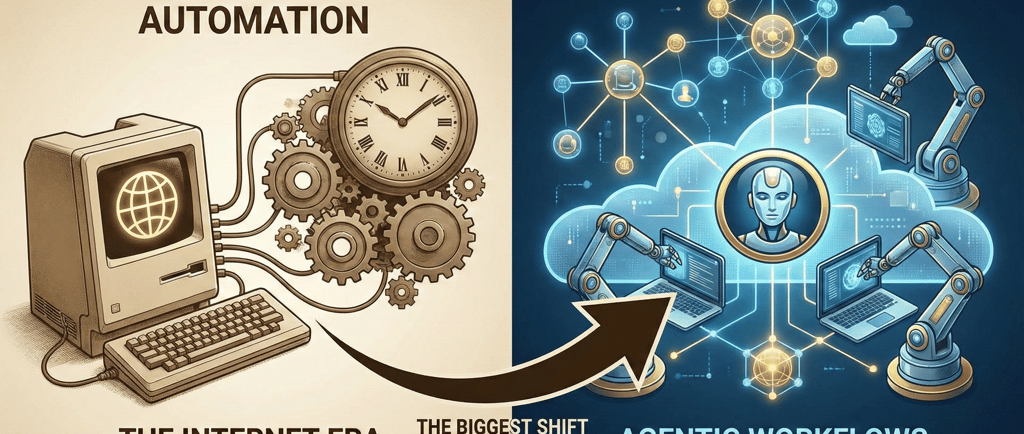
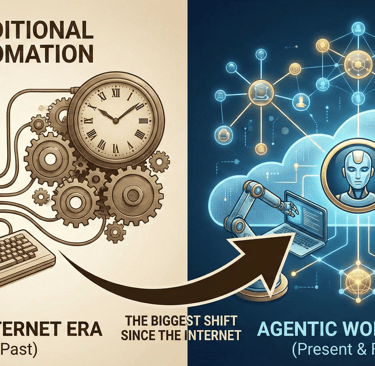
The old way of automation: you (or your consultant) manually connect every step. Tool A triggers Tool B, which sends data to Tool C. Every branch, every error handler, every edge case – configured by hand.
The new way: you describe what you want in plain English. The AI agent figures out the steps, writes the code, connects the tools, and fixes its own errors.
The analogy that makes it click:
Old Automation Agentic Workflow: Building a machine bolt by bolt. Hiring an engineer and describing the outcome. You configure every node Agent figures out the nodes it breaks → you fix it. It breaks → it fixes itself. You need to know the API Agent reads the docs itself Hours to build Minutes to describe
This isn't incremental improvement. This is a fundamental shift in who does the work.
The 4 Things Agentic Workflows Can Do That Traditional Automation Can't
1. Self-Healing: It Fixes Its Own Errors
The old problem:
Monday 9AM: Automation breaks Monday 9AM: You get an alert Monday 10AM: You diagnose the issue Monday 11AM: You push a fix Result: 2 hours of downtime, manual intervention required
The agentic way:
Monday 9AM: Workflow hits an error Monday 9AM: Agent reads the error message Monday 9AM: Agent tests a fix Monday 9AM: Agent iterates until it works Result: Zero downtime, zero human intervention
What this means for your business: automations that used to require a technical person on call to monitor and fix – now manage themselves. Your Saturday is yours again.
2. Natural Language Control: You Talk, It Builds
The old way: you explain your workflow to a developer or consultant, they translate it into logic, build it, and you hope they understood correctly.
The agentic way:
The agent interviews you first:
"Who triggers this workflow?"
"What should happen if the customer doesn't respond?"
"Are there any exceptions I should know about?"
Then it builds the system based on your answers – and updates it based on your verbal feedback.
Real example:
You: "When a lead fills out our form, send them a WhatsApp, add them to our CRM, and notify the sales team" Agent: "Got it. What should happen if the lead's phone number is invalid?" You: "Flag them for manual review" Agent: [Builds the entire workflow including the edge case you just described]
No more losing nuance in translation between business logic and technical implementation.
3. Security Built-In, Not Bolted On
The problem with traditional automation security:
Security is an afterthought. You build the workflow, then remember to add guardrails later (or forget entirely).
The agentic approach:
The LLM reviews every code change for vulnerabilities automatically. You define rules in plain English:
"Never share customer phone numbers with third-party services"
"Always encrypt data before storing"
"Require approval before sending emails to more than 100 people"
The agent enforces these guardrails on every action, every time.
For Israeli businesses handling customer data: this matters enormously for GDPR compliance and local privacy regulations – without needing a security expert to audit every workflow.
4. Instant Integrations – No More Reading API Docs
The old nightmare:
You want to connect your CRM to a new tool. You spend 3 hours reading API documentation, understanding authentication, handling rate limits, testing endpoints.
The agentic solution – MCP (Model Context Protocol):
You: "Connect this to our ClickUp workspace and pull all tasks due this week" Agent: [Uses MCP to understand ClickUp's API] [Writes the integration] [Tests it] [Done in 4 minutes]
MCP is essentially a universal translator for APIs. The agent understands how to talk to Google Sheets, Salesforce, Zendesk, WhatsApp – without you explaining a single line of documentation.
The WAT Framework: How to Think About Agentic Systems
This is the mental model that makes agentic automation make sense (WAT):
W – Workflows
Markdown-based SOPs (Standard Operating Procedures) that define what needs to happen.
Think of it as your employee handbook – written in plain English, describing the process step by step. The agent reads this and knows what to do.
Example:
# Lead Follow-Up Workflow 1. When a new lead comes in from the website 2. Check if they're already in CRM 3. If yes: notify their account manager 4. If no: create new record, send welcome WhatsApp, assign to next available sales rep 5. If no response in 48 hours: send follow-up 6. Log all actions in CRM
A – Agent
The "brain" that reads the workflow, decides which tools to use, and coordinates execution.
The agent doesn't just follow instructions rigidly – it reasons about edge cases, handles unexpected inputs, and makes judgment calls based on the context you've given it.
T – Tools
Python scripts or API connections that the agent uses to actually do things:
Send a WhatsApp message
Update a CRM record
Scrape a website
Generate a report
Book a calendar slot
The key shift: you used to wire these tools together manually. Now the agent decides which tool to use and when, based on what's needed.
The Future: Where Agentic Automation Is Heading in 2026-2027
From Reactive to Proactive Agents
Today's agents: wait for a trigger, then act.
Tomorrow's agents:
Agent scans your CRM every morning: "3 deals have had no activity in 14 days. Based on historical data, these are at risk. Recommended action: personal call from account manager. Want me to schedule the calls?"
Your agent becomes a business analyst that monitors your company 24/7 and flags risks before they become problems.
Multi-Agent Teams: Specialists, Not Generalists
Right now, most businesses run one AI agent that does everything. The next wave:
Manager Agent ├── Research Agent (finds prospects, gathers data) ├── Email Agent (handles all written communication) ├── CRM Agent (keeps records clean and updated) └── Analytics Agent (reports on what's working)
Each agent is a specialist. The manager agent coordinates them. This mirrors how a high-performing human team works – except it runs 24/7 at near-zero marginal cost.
A2A: Agents Talking to Each Other Across Companies
Agent-to-Agent (A2A) protocol – pioneered by Google – allows agents from different platforms to share context and coordinate:
Your Sales Agent (HubSpot) → talks to → Client's Procurement Agent (Salesforce) → talks to → Logistics Agent (your supplier's system)
What this enables: end-to-end business processes that cross company boundaries, all automated, all coordinated in real-time.
The business implication: in 2-3 years, your agent will be able to negotiate terms, place orders, and manage supplier relationships with minimal human involvement.
Long-Running Projects: Agents With Memory
The current limitation: AI agents lose context after each session.
The solution being built now: "harnesses" that pass structured notes between agent sessions – like a shift handover report.
Agent (Monday): "Completed market research. Key findings saved to /notes/week1.md. Next session: begin competitor analysis." Agent (Tuesday): [Reads notes from Monday] "Continuing from where we left off..."
For businesses: this means agents will be able to manage month-long projects – onboarding sequences, sales cycles, content calendars – without losing the thread.
Does This Mean n8n and Traditional Automation Are Dead?
No – and this is the most important nuance.
Everything you learned from building automations in n8n, Zapier, or Make gave you something irreplaceable:
Process Decomposition
You know how to break a business problem into logical steps. That skill doesn't disappear – it becomes the input for agentic systems. You describe the process; the agent executes it.
Systems Vocabulary
You understand webhooks, APIs, data transformation, triggers. This vocabulary lets you communicate clearly with AI agents about what you need – and debug when something goes wrong.
Debugging Intuition
You know where automations typically fail. That intuition makes you a better agent manager – you know what to check, what questions to ask, what guardrails to set.
Your role is shifting:
BeforeAfterBuilder – wiring individual API callsArchitect – designing the systemDeveloper – writing the logicManager – reviewing the outputTechnician – fixing errorsStrategist – defining the outcomes
The people who will win with agentic automation aren't the ones who know the most code. They're the ones who best understand their business processes.
What This Means for Israeli Businesses Right Now
If you haven't started with automation yet:
Good news: you can skip the hard part. You don't need to learn n8n from scratch if you're starting today. Agentic tools lower the barrier dramatically.
Start here:
Identify your 3 most repetitive workflows
Describe them in plain English (the WAT framework)
Let an agent build the first version
Review, refine, deploy
If you're already using n8n or traditional automation:
Your existing workflows don't need to be rebuilt. n8n remains excellent for:
Reliable, visual workflows you can show non-technical teammates
Simple integrations that work perfectly and don't need to change
Anything that fits the 10-minute rule
Add agentic tools on top for:
Complex logic that's painful to wire manually
Workflows that need to self-heal
New integrations where you'd otherwise spend hours reading docs
The Competitive Reality
Companies that adopt agentic workflows in 2026 will have a structural advantage that's very hard to overcome later:
Faster responses to customers
Lower operational costs
More consistent quality
Ability to scale without proportionally scaling headcount
The businesses that wait for the technology to "fully mature" will be competing against companies that have already compounded 12-18 months of efficiency gains.
FAQ: Agentic Workflows for Business
Do I need a developer to use agentic workflows?
Less than ever before. The whole point of agentic systems is that you describe outcomes in plain English. That said, having technical guidance for setup, security configuration, and edge cases significantly speeds things up – which is exactly what BizNova provides.
What's the difference between an AI agent and an automation?
Automation: follows a fixed script. If something unexpected happens, it breaks.
AI Agent: reasons about the situation, adapts to unexpected inputs, and makes judgment calls. It's closer to a junior employee than a conveyor belt.
Is this expensive?
The infrastructure costs are surprisingly low. Claude API calls for most business workflows cost cents per interaction. The investment is in setup, configuration, and training the agent on your specific processes.
How soon before this is mainstream for SMBs?
It already is. The tools exist today. The barrier is knowledge and implementation – not cost or availability. Businesses that act now have a meaningful first-mover advantage.
What's the first agentic workflow a business should build?
Customer support triage. It's the highest-volume, most repetitive workflow in most businesses – and the one where an agent that can reason (not just follow a script) makes the biggest immediate difference.
The Bottom Line
Agentic workflows aren't coming. They're here. The shift from "configure every step manually" to "describe the outcome and let AI figure it out" is happening right now – and it's compressing what used to take weeks into hours.
The businesses that understand this shift early – and build the right systems now – will operate at a fundamentally different level than those that don't.
Your job is no longer to wire the machine. Your job is to know your business well enough to describe what the machine should do.
That's a skill every business owner already has.
[📞 Ready to build your first agentic workflow? Book a free 30-minute strategy session with BizNova – we'll map out exactly where to start]
Related articles:
מעוניינים שנחזור אליכם? השאירו הודעה
058-4005318
זכויות שמורות ל- לBizNova
_____________________________________________________________________________________________________